Case study 06AI engineering · Quant
WUTIS
Four semesters at WUTIS: led a 3-person CRNN volatility team and a 5-person QNN portfolio team, and taught coding workshops; both teams I led won their semester pitches.
The problem
WUTIS is a student investment society in Vienna. In its Algorithmic Trading division, small teams build and pitch a trading or forecasting project each semester. I joined in October 2024 after a case study and a Superday. Leading meant turning a proposal into code that three to five students could build in parallel, then reporting what the backtest showed.
What I built
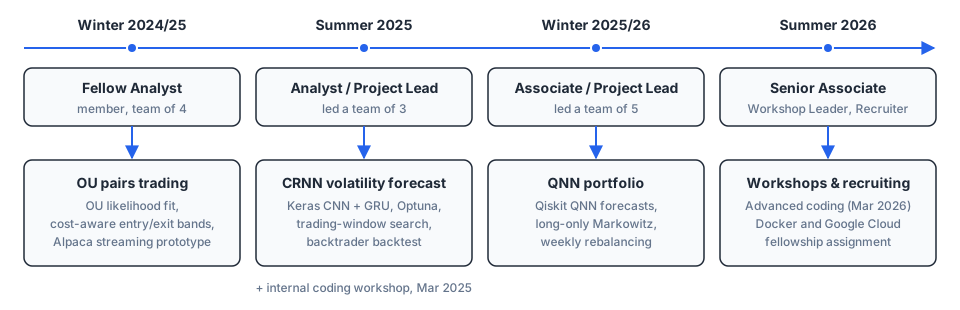
- Winter 2024/25, Fellow Analyst. In a four-person team I worked on the Python, strategy and project planning of an Ornstein–Uhlenbeck (OU) pairs-trading model.
- Summer 2025, Analyst / Project Lead. I proposed and led a three-person project forecasting volatility with a convolutional-recurrent network (CRNN). Code ownership was shared: I wrote the data pipeline and much of the model and trading code. In March 2025 I also ran an internal coding workshop.
- Winter 2025/26, Associate / Project Lead. I led “Quantum on Quantum”, a five-person project where quantum-neural-network (QNN) forecasts drive a portfolio optimizer. I wrote the QNN core and most of the data pipeline and was the top code contributor; teammates built the optimizer and backtest.
- Summer 2026, Senior Associate, Workshop Leader and Recruiter. In March 2026 I taught “Introduction to Advanced Coding” (OOP, trading APIs, project structure, Git) and “Docker and Google Cloud” (running a containerized Alpaca data client on Google Cloud). I also ran applicant coffee chats (September 2025 to February 2026) and wrote the summer-2026 fellowship assignment and a Superday case study.
How it works
- OU pairs. A grid over the hedge ratio picks the spread with the highest OU likelihood (closed-form maximum-likelihood estimates). Cost-aware entry and exit bands follow an optimal mean-reversion rule (after Leung and Li), re-fitted on a rolling window; a prototype pipeline is written to submit paired Alpaca orders at the bands.
- CRNN. Alpaca minute bars for SPY and VIXY plus technical indicators feed a Keras network (convolutions, then GRUs) forecasting SPY’s 60-minute rolling volatility one minute ahead. Optuna tunes it, a second Optuna search scores intraday trading windows, and a backtrader backtest trades VIXY on the forecast.
- QNN. Qiskit QNNs (EstimatorQNN via PyTorch’s TorchConnector, tuned with Optuna) forecast next-week returns for 12 assets and the 78 entries of their covariance matrix. A classical long-only minimum-variance (Markowitz) optimizer in cvxpy rebalances weekly from the covariance forecast alone, against an equal-weight benchmark. The deck’s QUBO slide is a next step; the code solves the convex problem.
Results
- Figure
- 2research teams led, of 3 and 5 people
- Figure
- 4semesters, from Fellow Analyst to Senior Associate
- count
- 12assets whose weekly returns and 78-entry covariance matrix the QNN team forecast to drive a cvxpy portfolio optimizer
- QNN portfolio team. The team delivered an end-to-end pipeline: Qiskit QNN forecasts of next-week returns and covariances for 12 assets, a classical long-only minimum-variance optimizer in cvxpy and weekly rebalancing, evaluated in a 16-month out-of-time backtest against an equal-weight benchmark. The optimized portfolio returned more than equal weight in that backtest.
- CRNN team. The team delivered a full research-to-backtest chain on minute bars: a Keras CNN-GRU volatility forecaster, two Optuna searches (model and trading windows) and a backtrader backtest of a VIXY strategy (backtest, no transaction costs).
- OU pairs. On GLD–SLV the model returned 6.11% a year at 13.01% volatility in an in-sample backtest.
What I learned
- Structure lets a team work in parallel. Separate modules, YAML configs and feature branches let three to five people build at once; my 2026 workshops taught exactly that.
- Check the data and the target before the model. Small details such as price jumps and overlapping windows decide whether a backtest means anything.
- Read the holdings before the P&L. A portfolio’s raw return hides its risk; a covariance forecast should be valid by construction, for example a factor model.
Notes
Links
- CRNN volatility forecasting: team pitch deck (WUTIS, June 2025)Open: CRNN volatility forecasting: team pitch deck (WUTIS, June 2025)
- Quantum on Quantum: QNN portfolio team pitch deck (WUTIS, January 2026)Open: Quantum on Quantum: QNN portfolio team pitch deck (WUTIS, January 2026)
- Follow-up: QNN forecasting in my bachelor thesisOpen: Follow-up: QNN forecasting in my bachelor thesis