Case study 07AI engineering · Quant
AI-assisted legacy modernization at Erste Digital
An AI pipeline that turns legacy Natural/Adabas banking code into as-is docs and review-ready Java/OSB integration code: 5 use cases, 10+ connectors delivered.
The problem
The legacy banking code I work with is Natural/Adabas on the mainframe. Building a Java/OSB integration connector for it starts with working out what the old code does: which programs call which, what the screens show, which business rules apply. Before the pipeline, a typical use case took more than three monthly release cycles. In a regulated bank, generated code needs evidence before anyone merges it.
What I built
I lead an internal AI accelerator team at Erste Digital, Erste Group’s technology subsidiary. Our AI modernization pipeline for this code produces as-is documentation and Java/OSB integration connectors, delivered as a pull request with complete, usable code for human review. I orchestrate its tooling in CI/CD: GitHub Copilot CLI, agents and reusable skills, MCP, Bash and a deterministic code transpiler.
How it works
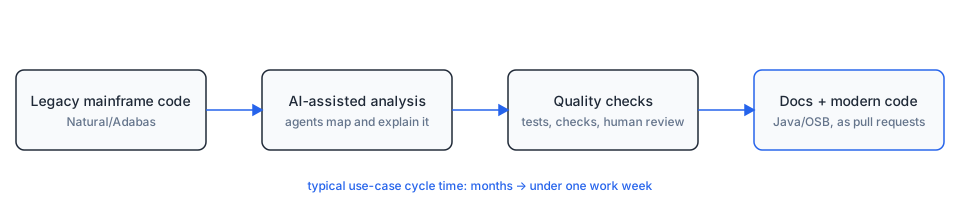
AI agents read the legacy Natural/Adabas code, explain what it does and draft the documentation and the modern Java/OSB integration code. Automated checks and a human reviewer sit between every generated change and the main branch, so nothing merges on the model’s word.
Results
- Figure
- 5complete use cases delivered with the pipeline
- Figure
- 10+Java/OSB integration connectors delivered
- Figure
- >80%shorter typical use-case cycle time: months to under one work week (n = 5)
As of August 2026 (my own figures):
- 5 complete use cases and 10+ connectors delivered with the pipeline.
- Typical use-case cycle time down by over 80%: from more than three monthly release cycles to under one work week and a single release (n = 5).
What I learned
- The gates are part of the product. In a bank, generated code is only useful if people trust it, so the checks and human review sit inside the pipeline.
- Document before generating. With the screens and business rules written down first, code and documentation can be checked against each other.
- Name the metric precisely. “Months to under a week” is cycle time; effort saved is a different claim, and I don’t make it.