Case study 05Quant
IMC Prosperity 4
Team entry: I built the fair-value models, quoting logic and research tooling. My team reached Phase 2. Round-1 test-run PnL rose from 1,817 to 4,789 XIRECs.
The problem
IMC Prosperity 4 (April 2026) is IMC’s algorithmic-trading competition: each team uploads one Python file that trades simulated products tick by tick. Rounds 1 and 2 were qualifiers: reaching Phase 2 took at least 200,000 XIRECs, the game’s currency, across both.
Both rounds traded two products. ASH_COATED_OSMIUM (ASH) stayed within about 20 of 10,000 on every public day; INTARIAN_PEPPER_ROOT (PEPPER) rose about 1,000 a day. Round 2 raised position limits from 50 to 80 and added two game-theory decisions.
What I built
In this team entry I built the fair-value models and quoting logic and wrote the trading code and research tooling:
- One trader, two engines, one per product, replacing an early shared quote builder.
- Research tooling: notebooks for stationarity, mean-reversion and time-of-day checks; a prosperity3bt harness that runs each version under a lenient and a strict fill model; parsers that match local runs to IMC’s website test runs.
- A submission archive: website test runs stored with their code and exports.
How it works
ASH: anchor/EMA market maker with inventory control. The product stayed close to a fixed anchor, so the engine makes markets around an anchored, EMA-adjusted fair value and keeps its inventory in check.
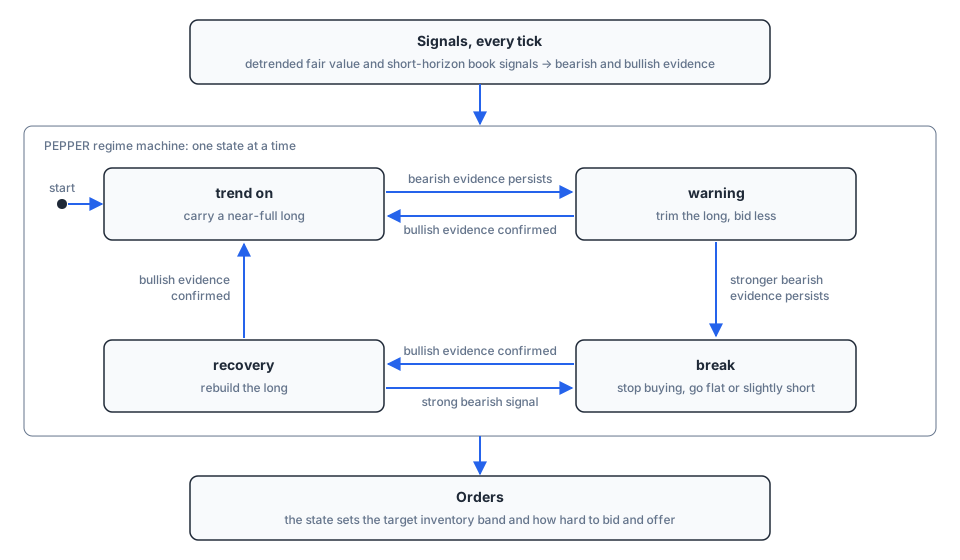
PEPPER: directional carry on a detrended fair value. A four-state regime machine decides how much of the drift to carry:
Round 2’s side decisions. In the Market Access Fee auction, the top half of bids won 25% more quote flow. Because only the top half had to be beaten, my analysis favored a mid-range bid over a maximal one, and I tabulated its break-even against the expected gain from the extra flow. For Invest & Expand, a 50,000-XIREC budget split across three levers, one paid by rank against the field, I solved five field scenarios by exact integer grid search, cross-checked the base case with SciPy’s trust-constr optimizer and weighted the pick toward speed-heavy fields.
Results
- outcome
- Phase 2my team cleared the 200,000-XIREC qualifying bar over Rounds 1–2
- Figure
- 1,817 → 4,789Round-1 test-run PnL in XIRECs across 8 archived submissions on one fixed 1,000-tick test sample, about 2.6×
- Figure
- −254 → −56Round-1 test-run max drawdown in XIRECs, first vs last submission, same test sample
- Figure
- +6.1%local six-day backtest gain from wider ASH quotes under lenient fills (Round-2 position limits); strict fills never fill resting quotes, so they cannot test it
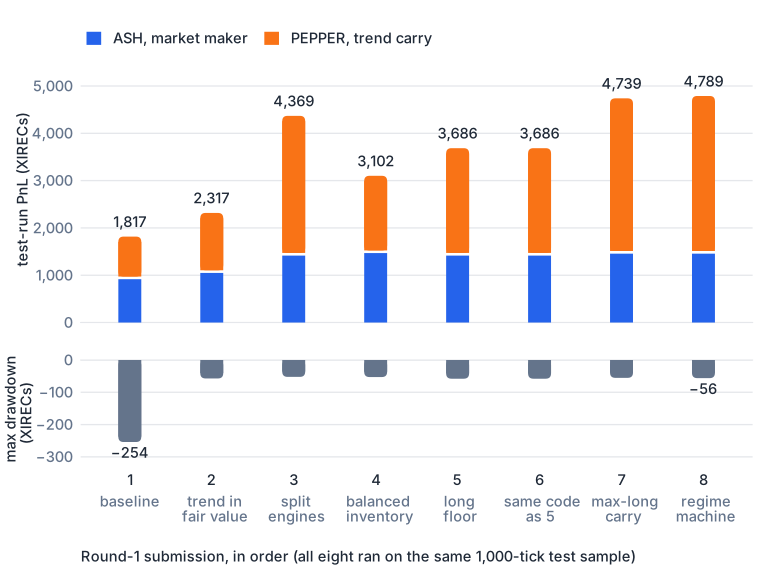
Round 1, IMC website test runs. PnL rose from 1,817 to 4,789 XIRECs (about 2.6×) across eight archived submissions on the same 1,000-tick sample, while maximum drawdown shrank from 254 to 56 XIRECs. About 82% of the gain came from the PEPPER leg.
Round 2, IMC website test runs. 7,760.69 (v1) and 8,036.81 (final candidate) XIRECs. Each submission drew a new sample (the unchanged PEPPER leg moved by 180), so the pair cannot isolate the change.
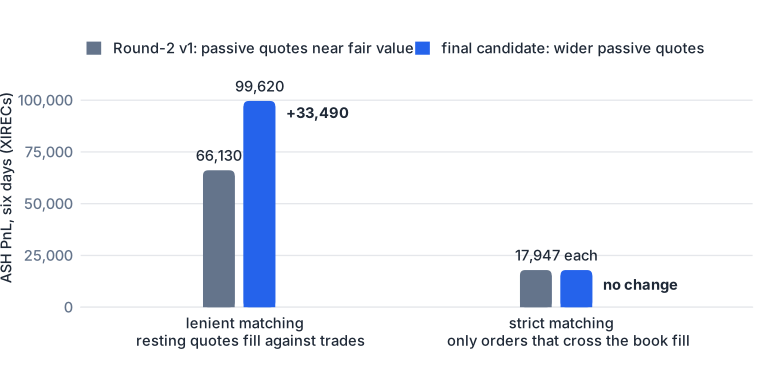
Local backtest: fill-model check. Widening ASH’s passive quotes added 33,490 XIRECs (+6.1%) over the six public days under lenient matching, and nothing under strict matching, where resting quotes never fill. The strict run therefore could not test the change, and the gain depends entirely on how the exchange fills resting quotes. The change became the Round-2 final candidate on the lenient result.
Qualification. My team cleared the 200,000-XIREC bar and reached Phase 2, which IMC confirmed by e-mail on 22 April 2026.
What I learned
- The fill model can outweigh the strategy. In local backtests the same ASH engine made 66,130 or 17,947 XIRECs over six days, depending only on the fill model.
- Inventory was the biggest lever. The one version that held a more balanced PEPPER inventory gave up 1,267 XIRECs of test-run PnL; carrying the drift paid.
- A fixed test sample is fair but small. Eight runs on the same 1,000 ticks compare cleanly, but repeated tuning can fit that sample.
- A regime filter is hard to test without a regime change. In a replay of the public data, the last Round-1 test version switched state more than 200 times a day; the slower Round-2 settings never reached break. PEPPER’s trend never broke, so the data could not decide between them.
Notes
Source. Phase 2: e-mail from IMC Prosperity, 22 Apr 2026, “Congratulations on your Prosperity success so far”: “Great job on successfully completing your first mission … your journey enters a whole new phase”. Round 3 opens Phase 2.