Case study 03AI engineering · Quant
Prediction-market matching and arbitrage
An LLM contract-matching pipeline over ≈ 255k Kalshi and Polymarket markets, feeding a fee-aware arbitrage scanner. Built solo, with 529 automated tests.
The problem
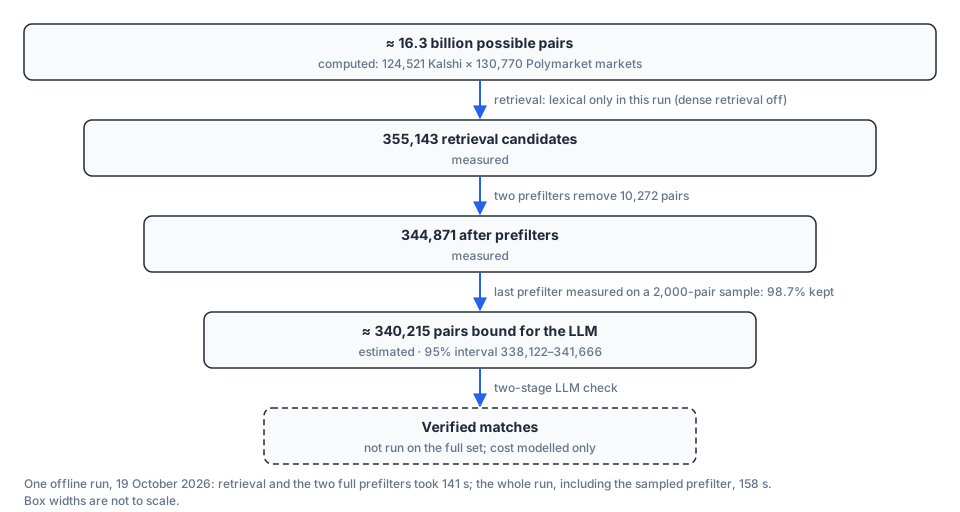
Kalshi and Polymarket often list the same question (an election, a game, a price on a date) as separate contracts. If YES on one venue plus NO on the other costs less than the $1 the pair pays, after fees, the gap is a candidate arbitrage, real only if the contracts truly match and both legs fill at the quoted prices. Titles that read alike can differ in strike, date or settlement source, and a false match turns a hedge into an open position. The two venues’ 124,521 and 130,770 markets make about 16.3 billion possible pairs.
What I built
It started as a WUTIS student-team project in winter semester 2025/26. From April 2026 I rebuilt it alone as a new codebase: an event-driven Python system that crawls every open market on both venues, matches equivalent contracts with a retrieval and LLM funnel, and scans their order books for two-leg arbitrage after fees. In October I added an evaluation set and a cost model. It reads only public venue data.
How it works
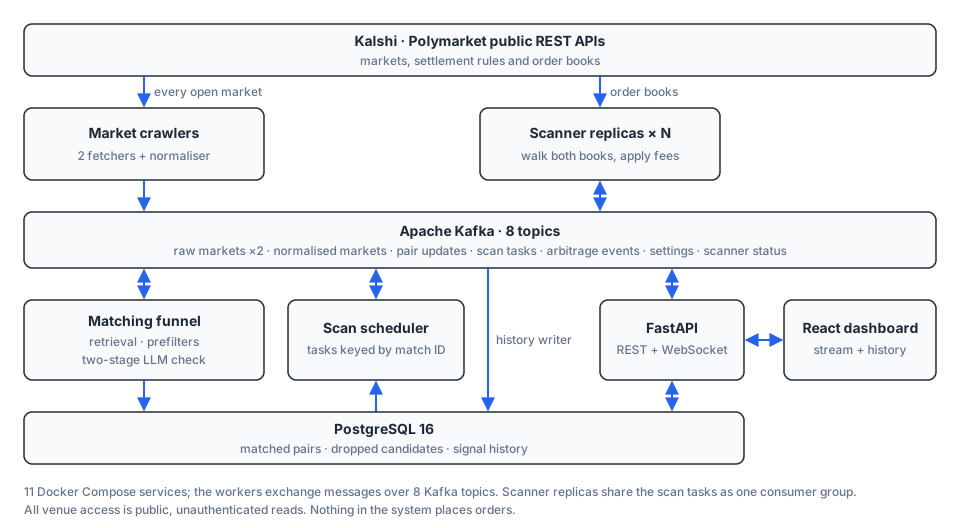
Crawlers page through both venues’ public APIs into Kafka, and a normalizer maps their markets into one binary-contract model.
The matcher runs a recall-first funnel. Lexical (TF-IDF) retrieval can be fused with dense (MiniLM) retrieval by reciprocal-rank fusion, and prefilters drop clear mismatches. A two-stage LLM check follows: by default a strict check runs first and a second model reviews confident approvals; an opt-in cascade runs a cheap triage first. Per-run caps on calls and dollars bound escalation; pairs over budget wait for the next run. Verdicts are cached under a key that includes the prompt’s hash, and dropped candidates are logged so recall can be audited.
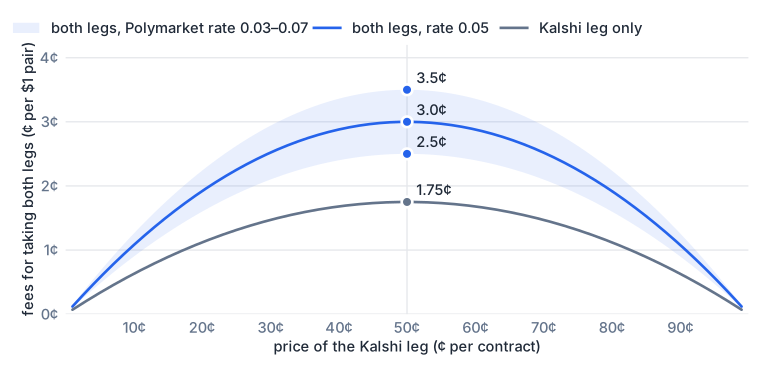
A scheduler turns matched pairs into scan tasks keyed by match ID, shared by scanner replicas in one consumer group. Each scanner fetches both order books, walks their depth for both constructions (Kalshi YES + Polymarket NO, and the reverse), applies each venue’s fees and skips stale books. Kalshi charges 0.07 × C × P × (1 − P) to take C contracts at price P, times a per-series multiplier refreshed daily; Polymarket fees follow each market’s own schedule.
Results
- Figure
- ≈ 255kmarkets: 124,521 on Kalshi + 130,770 on Polymarket (Oct 2026)
- Figure
- ≈ 340kestimated pairs left for LLM checks, of 355,143 candidates
- Figure
- $49–64modeled cost of a full LLM pass (small model, batch + caching)
- Figure
- 529automated tests, all passing (Nov 2026)
The figures below are measured offline or modeled, and labeled as such.
Funnel (measured, one offline run, 19 October 2026). Retrieval gave 355,143 candidate pairs and two prefilters left 344,871, in 141 s. A 2,000-pair sample of the last prefilter kept 98.7%, which puts an estimated 340,215 pairs in front of the LLM. Dense retrieval was off.
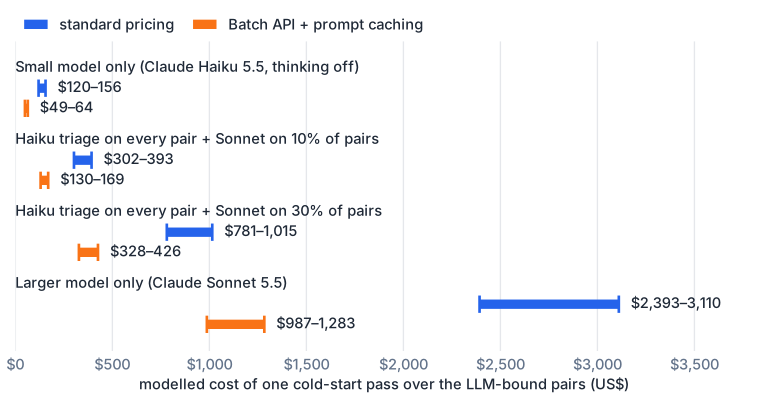
Cost (modeled, not billed). One cold-start pass over those pairs prices at $120–156 with a small model (Claude Haiku 5.5), or $49–64 with batching and prompt caching, against $2.4–3.1k with a larger model (Claude Sonnet 5.5) alone.
Evaluation harness (built). A 400-pair set from a May 2026 snapshot covers seven strata, from strike ladders to a random control, labeled from settlement: 100 hard negatives, 248 weak positives, 52 unlabeled. The harness reports false-approval rates with Wilson bounds.
Fees and settlement (analysis). Near 50¢, taking both legs costs 2.5–3.5¢ in fees per $1 pair at Polymarket rates of 0.03–0.07. Settlement divergence is the main tail risk: three verified cases show the venues settling what looked like the same event differently.
What I learned
- Retrieval narrows; the LLM sets the bill. Prefilters removed only a few percent, so cost control comes from model choice, batching and caching, not from filters that would cost recall.
- Price the pipeline before running it. Across the four set-ups in the cost chart, one full pass is modeled at $49 to $3,110.
- Settlement gives negative labels for free. Opposite outcomes prove a false match; matching outcomes can be coincidence.
- Fees and settlement rules decide whether a gap survives costs and whether a hedge is a hedge.